
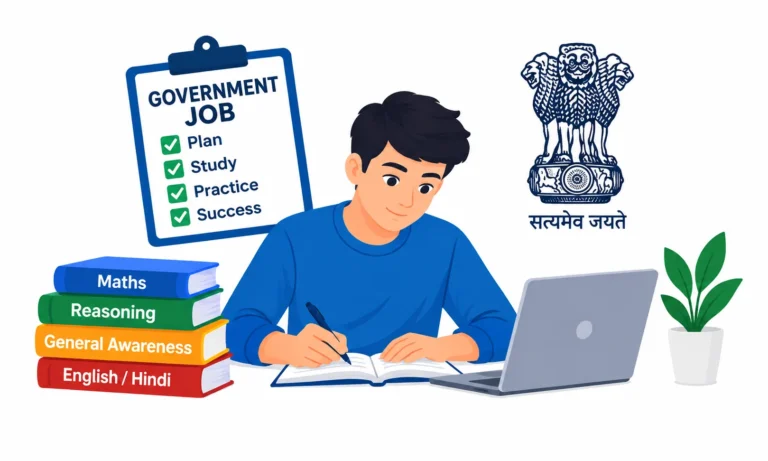
Preparing for a government exam demands discipline, consistency, and a well-thought-out strategy. A great many people who start off fail not because they lack the necessary ability, but because they have no structured method. If one understands the syllabus, the exam pattern, and the various preparation techniques, their chances of succeeding can be greatly improved.
The guide gives a step-by-step account of how to get ready for government exams, with a particular focus on those who are new to such exams.
Understand the Exam & Syllabus
Before starting preparation:
-
Find out which exam it is (for example, SSC, Banking, Railway, state exams, etc.).
-
Download the official syllabus.
-
Understand the exam pattern and marking scheme.
Quick Answer: How Do You Prepare for a Government Exam?
Preparing for a government exam takes five steps:
Read the official notification and syllabus.
-
Study the previous years’ question papers.
-
Build a fixed daily study routine.
-
Take regular mock tests and analyse every mistake.
-
Revise the same material many times instead of collecting new material.
Most students who stay consistent need 6–12 months for exams like SSC, banking and railways. UPSC usually needs 12–24 months.
How Career Wave Guides Beginners to Government Job Selection
Step 1: Pick One Exam First
Many people try to get ready for the UPSC, SSC, banking and state PSC exams at the same time. This might seem like a good idea, but it usually ends up with you not learning anything properly.
Here is an easy way to decide:
|
If you are… |
Think about starting with |
|---|---|
|
A graduate who wants a job quickly |
SSC CGL, SSC CHSL or IBPS PO/Clerk |
|
Good with math and reasoning |
Banking exams like IBPS or SBI |
|
Interested in government work and ready to study for a long time |
UPSC Civil Services or your State PSC |
|
Have a 10th or 12th certificate or an ITI or diploma |
Railway exams like RRB, SSC MTS or SSC GD |
Once you are comfortable with one exam, you can try another related one. For example, SSC and banking have a lot in common in math, reasoning and English.
Step 2: Read the Official Notification Yourself
This seems simple. It is often missed.
Do not depend on a picture from a Telegram group. Go directly to the websites:
-
UPSC: upsc.gov.in
-
SSC: ssc.gov.in
-
IBPS: ibps.in
-
SBI Recruitment: sbi.co.in/web/careers
-
Railways: the website of your regional RRB
-
State PSCs: your state commission’s official portal
⚠️ Tip to trust: Exam formats, age limits and rules can change. Always check the recent official notification before you make any plans. Fake job notices are common online, and real recruitment bodies never ask for money through WhatsApp or personal bank accounts.
Step 3: Let Years’ Papers Be Your Guide
One thing you should do from this guide is what is mentioned here.
Before opening any book, spend 2 to 3 days looking at the question papers from the last 5 years. At this point, you are not trying to solve the questions, just learning what they are like.
Ask yourself:
-
What topics come up again and again?
-
How deep do the questions go? Are they about facts or ideas?
-
What topics do not come up often?
This activity will make your worries about the syllabus much less because the exam shows that not all topics are equally important.
Step 4: Create a Realistic Study Plan
A study plan is only useful if you can follow it on a bad day.
For full-time students (6 to 8 hours a day):
|
Time block |
Focus |
|---|---|
|
Morning (2 to 3 hours) |
Your difficult subject, like math or general studies |
|
Midday (1.5 to 2 hours) |
Practice with reasoning or English |
|
Afternoon (1 hour) |
Current affairs |
|
Evening (1.5 to 2 hours) |
Review and practice questions |
|
Weekly |
1 to 2 full mock tests with a detailed review |
For people who work (2 to 3 hours a day):
-
On weekdays in the morning (1 hour): current affairs plus one topic.
-
On weekdays in the evening (1 to 1.5 hours): practice questions.
-
On weekends: tests and review.
Working people often feel they can’t keep up. Many of them pass the exams this way. The difference is how many hours they study. Two focused hours every day are better than ten hours on Sunday and nothing else.
Step 5: Importance of Previous Year Question Papers
Solving previous year papers helps candidates:
-
Understand question patterns
-
Identify frequently asked topics.
-
Improve speed and accuracy.
It is one of the most effective preparation tools.
Step 6: Practice & Mock Tests
-
Attempt topic-wise practice questions.
-
Take full-length mock tests.
-
Analyze mistakes after each test.
Mock tests improve time management and confidence.
Step 7: Revision Strategy
Regular revision is essential:
-
Make short notes
-
Revise weekly and monthly
-
Focus on weak areas
Frequently Asked Questions
How many hours should I study for a government exam?
If you want to succeed in a government exam, most people who study spend between six and eight hours each day. Those who work can manage between two and three hours. It is the consistency of study and the quality of the work that matters more than the number of hours.
Can I prepare for government exams without coaching?
Yes, you can prepare for government exams without coaching. Many candidates pass by studying on their own. They use books, past papers, online mock tests and free government resources such as NCERT books. Coaching can give structure. It is not necessary.
Which government exam is easiest to crack?
No government exam is really easy because the competition is high in every exam. For graduates, the SSC and banking exams feel easier than the UPSC. The reason is that the syllabus for SSC and banking exams is shorter and the questions are more predictable.
How long does it take to prepare for SSC CGL?
If you study every day and stay focused, most people need about six to twelve months to prepare for the SSC CGL. The exact time depends on how strong you are in maths and English.
Is it possible to prepare for a government exam while working?
Yes, you can prepare for a government exam while working. You can study two to three hours on weekdays. Have longer sessions on weekends. Planning and staying consistent are the keys to success.
Final Words from DigiDisha
Cracking a government exam isn’t an IQ contest. It’s a test of endurance and strategy.
The people who get selected aren’t always the class toppers. They’re the ones who show up every day, stick to a limited set of resources, learn from their mock-test mistakes, and stay patient when results take time.
Your journey begins today. We’re rooting for you.
— The DigiDisha Team