
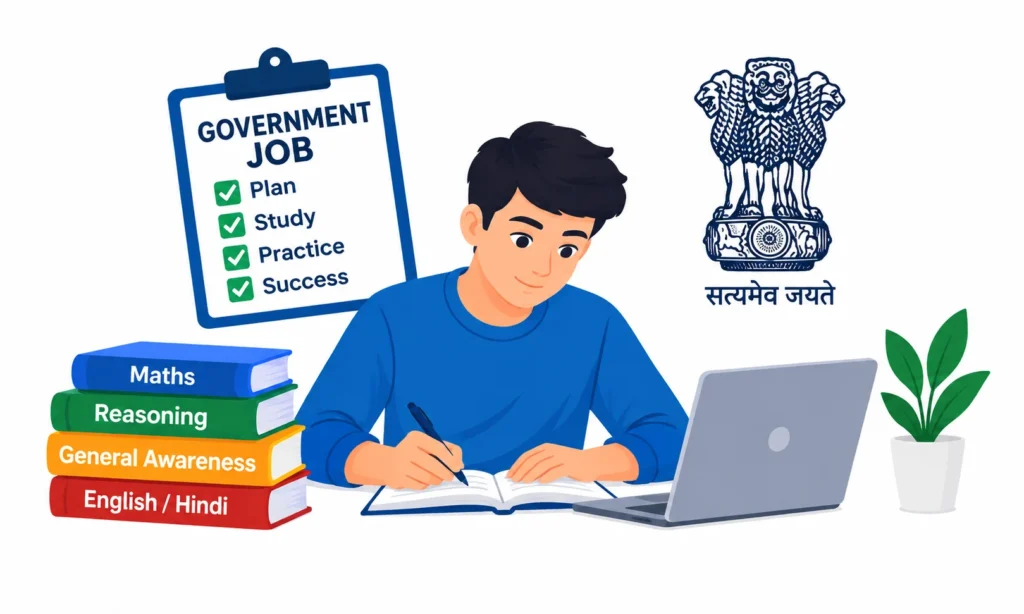

Making the decision to prepare for a government position in India is a major turning point in one’s life. If your goal is job security, social prestige, or simply the real wish to serve the public, you are about to enter a difficult journey.
Each and every year more than three crore candidates take part in the competitions for the small number of posts available with the UPSC, SSC, Banking, Railways, State PSCs, and Defence exams.
This is the harsh reality: The majority of people who try to achieve their goals don’t fail because they are unintelligent; instead, they fail since they begin without having a clear plan, blindly pursue every notification, and end up burning out by the halfway point.
At DigiDisha we have created the following step-by-step roadmap to take a confused beginner up to a confident candidate who is ready for the exam.
Quick Summary (If You’re Short on Time)
- Decide on your area of focus early on: it’s not a good idea to attempt to prepare for the UPSC, the SSC, and banking at the same time. Instead, select one main field according to your strengths.
- The Syllabus is like a Bible—don’t spend a single rupee on books until you’ve printed out the official syllabus and have looked at the question papers from the last five years.
- Follow the 3-Stage Timeline:
- Months 1–6: Foundation & Basics
- Months 7–12: Core Syllabus & Self-Notes
- Months 13–18: Intensive Mocks & Active Revision
- Don’t accumulate materials: one topic should correspond to one standard book. It is infinitely better to go through one book five times than to read five different books once.
- See Mocks as a mirror since writing the tests is only half the struggle; it is by analysing your errors in an “Error Log” that you actually end up getting selected.
Step 1: Pick Your Core Exam Category (Don’t Be an “Exam Hopper”)
The most serious error that people make when they are just starting out is becoming an “exam hopper”, which means applying for every single job advertisement that appears on Telegram or WhatsApp.
Although subjects such as English, Maths, and Reasoning are all present, the speed, pattern of questions, and level of analytical thinking required in each exam are entirely different.
1. Civil Services & State PSCs (UPSC, UPPSC, BPSC, MPPSC, etc.)
- What it demands: Deep conceptual clarity, heavy reading habits, essay writing, and analytical thinking.
- Core Areas: General Studies (Polity, History, Economy, Geography, Environment, Science), CSAT, and optional subjects.
- Best suited for: People who love reading, analyzing policies, and expressing ideas in structured long-form writing.
2. SSC & Central Exams (SSC CGL, CHSL, CPO, MTS)
- What it demands: Mental calculation speed, quick formula application, strong grammar, and memory for static general knowledge.
- Core Areas: Quantitative Aptitude, Reasoning, English Comprehension, and General Awareness.
- Best suited for: Candidates who are comfortable with school-level maths and fast-paced multiple-choice questions.
3. Banking & Insurance (SBI PO/Clerk, IBPS PO, RBI Grade B)
- What it demands: High-level logical puzzles, data interpretation, fast reading comprehension, and financial awareness.
- Core Areas: Advanced Reasoning, Quantitative Aptitude, English, and Banking Awareness.
- Best suited for: Candidates with sharp analytical logic who perform well under strict, sectional time limits.
4. Railways & Defense (RRB NTPC, Group D, CDS, AFCAT, CAPF)
- What it demands: Strong basic science, arithmetic, reasoning, and physical fitness (for defense roles).
- Best suited for: Aspirants looking for direct, concept-based questions with practical problem-solving.
DigiDisha Mentor Tip: Be brutally honest with yourself. If heavy theoretical reading puts you to sleep, avoid Civil Services and focus on SSC or Banking. If mental math makes you anxious, don’t jump directly into high-speed banking exams. Pick what aligns with your natural abilities.
Step 2: Decode the Syllabus and Previous Year Questions (PYQs)
Before you buy standard books or pay for online coaching, spend your first two weeks doing this essential groundwork:
1. Print the Official Syllabus
Go directly to the official commission websites (upsc.gov.in, ssc.gov.in, ibps.in). Download and print the notification syllabus. Pin it right above your study desk. If a topic is not mentioned in the syllabus, you don’t need to read it—period.
2. Break Down Big Subjects into Micro-Topics
Don’t just write “Indian History” on your checklist. Break it down into clear, manageable units:
- Ancient: Indus Valley Civilization, Vedic Period, Buddhism & Jainism, Mauryan Empire.
- Modern: 1857 Revolt, Indian National Congress sessions, Gandhian Phase, Freedom Movements.
3. Spend 10 Days with Past Papers (PYQs)
Don’t try to solve them with a stopwatch just yet. Simply read through 5 years of past exam papers to understand:
- Which topics appear year after year?
- Are questions straightforward facts or deeper analytical problems?
- How much weight is given to static subjects versus current affairs?
Phase 1: Foundation Building (Months 1 to 6)
- Get your basics straight: Read NCERT textbooks (Class 6 to 12 for GS) or brush up on basic arithmetic tables, squares, cubes, and English grammar rules.
- Build a reading habit: Spend 45 minutes every morning reading a quality newspaper (The Hindu or The Indian Express).
- Focus on understanding, not speed: Don’t worry about shortcuts or tricks right now. Understand why a formula works or why a historical event happened.
Phase 2: Syllabus Coverage & Smart Notes (Months 7 to 12)
- Finish the remaining syllabus using one standard reference book per subject.
- Prepare concise, high-yield summary notes. Write only facts, formulas, and concepts you tend to forget—do not copy the textbook into your notebook.
- Start attempting chapter-wise quizzes right after finishing any topic.
Phase 3: The Final Lap (Months 13 to 18)
- Shift your daily routine from passive reading to active testing.
- Take 2 to 3 full-length mock tests every week under strict, exam-like conditions.
- Revise your short notes repeatedly to keep high-frequency formulas and facts fresh in your mind.
Step 3: Stop “Material Hoarding” (Stick to the Standard Kit)
A classic trap for beginners is collecting hundreds of unread PDFs from Telegram groups and stacking their desks with five books for every subject.
Remember: You will clear the exam by revising one good book 5 times, not by skimming 5 different books once.
Here is the tried-and-tested beginner starter kit:
1. Quantitative Aptitude / Mathematics
- For Concept Building: RS Aggarwal (Quantitative Aptitude) or Rakesh Yadav / Abhinay Sharma concept notes.
- For Practice: Previous Year Question compilations (Kiran Publication or Pinnacle).
2. Reasoning Ability
- For Concepts: MK Pandey (Analytical Reasoning) or RS Aggarwal.
- For Practice: Sectional mock tests on platforms like Testbook or Oliveboard.
3. General English
- For Grammar: Plinth to Paramount by Neetu Singh or High School English Grammar by Wren & Martin.
- For Vocabulary: Word Power Made Easy by Norman Lewis (read one session daily).
- For Comprehension: Daily editorial reading.
4. General Studies (GS / GK)
- For Static GK: Lucent’s General Knowledge + NCERT summaries.
- For Indian Polity: Indian Polity by M. Laxmikanth (essential for UPSC, State PSCs, and SSC).
- For Modern History: A Brief History of Modern India (Spectrum by Rajiv Ahir).
Step 4: How to Handle Current Affairs (Without Wasting Hours)
Current affairs is an endless ocean. If you aren’t careful, it will swallow 3 to 4 hours of your day with very little return on investment.
Here is a practical, sustainable way to handle it:
Daily Newspaper (30–45 Mins) ──► For vocabulary, reading speed & broad context
Monthly PDF Compilation ──► For organized facts, dates & exam-specific points
Weekly / Monthly Quizzes ──► For active recall & retention
- Don’t make daily handwritten notes from newspapers: It takes hours and is rarely sustainable.
- Rely on monthly compilations: At the end of every month, download a curated monthly current affairs booklet from trusted sources (like VisionIAS, AffairsCloud, or InsightsIAS) and highlight directly on it.
- Target window: Most competitive exams focus on events from the 12 to 15 months leading up to the preliminary exam date.
4 Common Mistakes Beginners Need to Avoid
- Studying in secret without testing yourself: Reading for 8 months without attempting a timed quiz creates a false sense of security. Start writing mini-quizzes within your first month.
- Ignoring mental and physical health: Multi-year preparation takes a toll. Get 7 hours of sleep, take a 20-minute walk every day, and give yourself half a day off every week to recharge.
- Switching study sources too often: Stick to your chosen books. Every time you switch to a new author, you restart your mental memory map from zero.
- Waiting for “100% syllabus completion” before taking mocks: No serious aspirant ever feels 100% ready. Start taking sectional tests once you have finished about 30% to 40% of the syllabus.
Frequently Asked Questions (FAQs)
Can a beginner clear a government job on their first attempt?
Yes, absolutely. First-attempt success comes down to syllabus clarity, consistent daily revision, and attempting at least 50+ full-length mock tests before the actual exam.
Is coaching mandatory, or is self-study enough?
Coaching can give you an initial routine, but it is not mandatory. With the wealth of standard books and high-quality online mock platforms available today, self-study is more than enough to get selected.
How many hours should I study daily as a complete beginner?
Start small with 3 to 4 hours of focused study. As your concentration and sitting habit improve over the first 6–8 weeks, gradually build up to 6–7 hours.
When is the ideal time to start for 2026–2027 exams?
Right now. An 18-to-24-month preparation window gives you enough time to build genuine conceptual clarity, finish standard books without anxiety, and practice hundreds of mock tests.
Final Words from DigiDisha
Cracking a government exam isn’t an IQ contest. It’s a test of endurance and strategy.
The people who get selected aren’t always the class toppers. They’re the ones who show up every day, stick to a limited set of resources, learn from their mock-test mistakes, and stay patient when results take time.
Your first step today: Print the official syllabus of your target exam, clear your study table, and start with your foundational reading.
Your journey begins today. We’re rooting for you.
— The DigiDisha Team
Disclaimer: Exam dates, eligibility, and syllabus are based on previous notifications and public information. Official bodies may update them. Always verify with the conducting authority before applying.